

December 19, 2025
Case STudy
Transforming Diabetes Education with VR Simulation
NHS England’s Diabetes Team were concerned by recent statistics over clinician and patient confidence in the management of diabetes-related emergencies in hospitals. They were therefore looking for ways to enhance the training of junior and non-specialist doctors in managing emergencies in type 1 diabetes. High staff turnover in the NHS and the relatively low numbers…
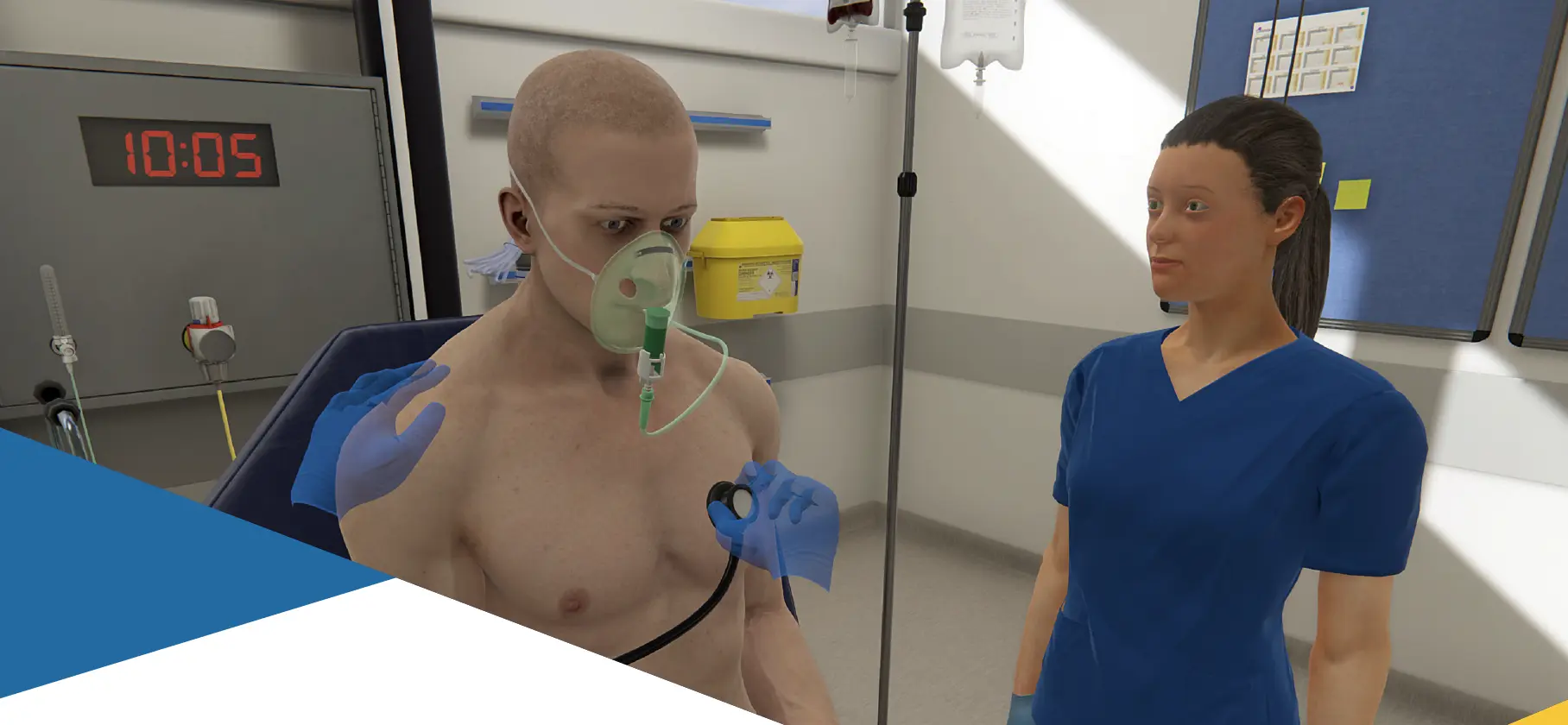
NHS England’s Diabetes Team were concerned by recent statistics over clinician and patient confidence in the management of diabetes-related emergencies in hospitals. They were therefore looking for ways to enhance the training of junior and non-specialist doctors in managing emergencies in type 1 diabetes.
High staff turnover in the NHS and the relatively low numbers of specialist clinical staff makes it difficult for specialist diabetes teams to provide training to non-specialists. This has the potential to expose people with type 1 diabetes to risk when they are admitted to hospital.
Moreover, people with type 1 diabetes have voiced concerns about how knowledgeable healthcare staff will be about their diabetes when they are receiving hospital treatment.
Simulation – the practice of training clinicians with manikins and actors in mock emergency situations -is frequently used to supportthe development of healthcareprofessionals’ skills and competencies.It has long been recognized as aneffective tool for preparing cliniciansfor practice but is expensive, time-consuming and under-used in manyinstitutions.
Technological developments have seen virtual reality (VR) emerge as method of delivering simulation efficiently and effectively. Encouraged by the long-term use of VR simulation in industries such as aviation, the NHS Diabetes Programme decided to explore how effective such training would be in offering junior doctors a safe and risk-free environment in which to practice managing diabetes emergencies.
Supported by funding from Novo Nordisk, the Oxford Medical Simulation (OMS) VR medical simulation platform was used to run a pilot study at University Hospital Southampton and Queen Alexandra Hospital, Portsmouth.
39 junior clinicians working in the specialities of Emergency Medicine and Acute Medicine were given access to four immersive, clinically realistic scenarios in which they had to manage a virtual patient as they would in real life.
The study aimed to demonstrate whether these scenarios could impact confidence and clinical competencies in managing diabetes emergencies.
This improvement would not only improve real life practice and patient care, but also provide an enjoyable learning experience to encourage regular engagement.
The clinical project planning was conducted collaboratively, involving two senior Diabetes Consultants, a Specialist Registrar in Diabetes, an Emergency Medicine Consultant and a person with type 1 diabetes. The scenario were built and run on the OMS VR Platform.
Of the 39 participants, none had prior experience of VR training or gaming tools.
RESULTS
100% of participant deemed the scenarios suitable for their level of practice and 100% stated that the VR scenarios would improve their daily practice.
One participant commented, ‘honestly this was the single most useful learning experience I’ve had so far in my medical training’ .
72% of participants expected that they would use the knowledge acquired from the VR experience within a week, and 100% expected they would use it within the next three months.
Before VR, the mean trainee confidence in managing the emegency of Diabetic Ketoacidosis (DKA) – on an eight-part Likert scale -was 3.92 (3.38-4.47). After VR, thisincreased to 5.41 (4.79-6.03).
Therefore, the mean confidence in managing patients with diabetic emergency increased by 28% after VR training.
SUMMARY
The trainee experience in VR was excellent and led to significantly increased confidence in managing diabetes emergencies. This corresponds to Kirkpatrick Level 2 learning.
All trainees felt they would use what they had learned in their daily practice in the near future.
The results of the study demonstrate that VR is a useful and well-liked educational tool for doctors. The study will now be extended to more participants and a crossover trial comparing VR simulation to traditional simulation is planned.
Related
Ready to get real?
See how OMS can help your organization build confidence, competence, and clinical readiness for today’s healthcare.
