

May 28, 2026
post
Using Your Voice: Communicating with AI-Driven Virtual Patients
What does it truly mean for a learner to be ready – and are we doing enough to get them there?
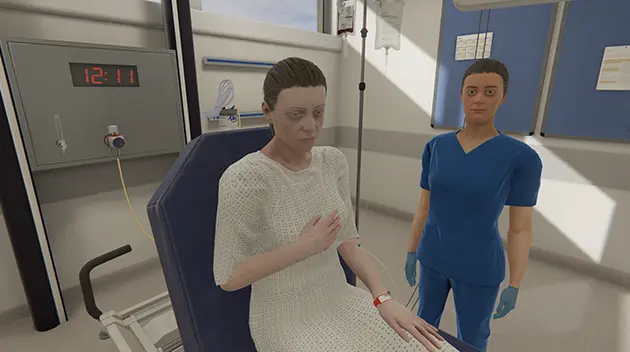
Talking with a patient is one of the best ways for healthcare professionals to hone their communication skills – gathering history, explaining rationale, building rapport, or even having difficult conversations.
These ‘soft skills’ are not only vital for the patient experience but are also notoriously challenging to teach and measure. How do you assess whether a learner has genuinely built rapport? How do you give meaningful feedback on empathy? And how do you create the conditions for those skills to be practised safely, repeatedly, and at scale?
Closing the Communication Gap
Most clinical simulations focus on the ‘what’, like the diagnostics or treatment decisions. That’s a valuable and integral part of any simulation program, however, the opportunities to practice meaningful therapeutic communication in traditional simulation are limited.
Many manikin-based simulations fail to bring the realism necessary to drive stakes, taking away from the real world expectations of clinical practice. While standardized patients are another option, it’s nearly impossible to guarantee the same experience from the first through the last learner of the day.
AI-powered virtual reality simulations close the loop on communication skills. These simulations place the learner directly in front of the patient, family member, or colleague, and the learner must autonomously build rapport and communicate effectively.
The underlying AI in these types of scenarios means that virtual patients can understand, process, and respond to what the learner has said. So if the learner says something untoward,the virtual patient will respond accordingly – and with emotion.
Communication scenarios then shift the focus onto the ‘how’: the professional handoff, the empathic exchange, or the structured report under pressure. Take a geriatric care scenario, for example. Learners must quickly build trust with an isolated patient navigating loneliness and memory loss. They must know to ask questions that provide
insight into the patient’s environmental limitations, keeping social determinants of health top of mind.
They must then communicate their findings to the patient, ensure understanding, and create an environment that leads with empathy. OMS Communication scenarios shift the learner’s mindset from collecting and analyzing data to communicating what they observe into clear, actionable, person-centred language, closing communication gaps and ensuring understanding both from a patient and interprofessional perspective.
Teaching and Measuring Soft Skills
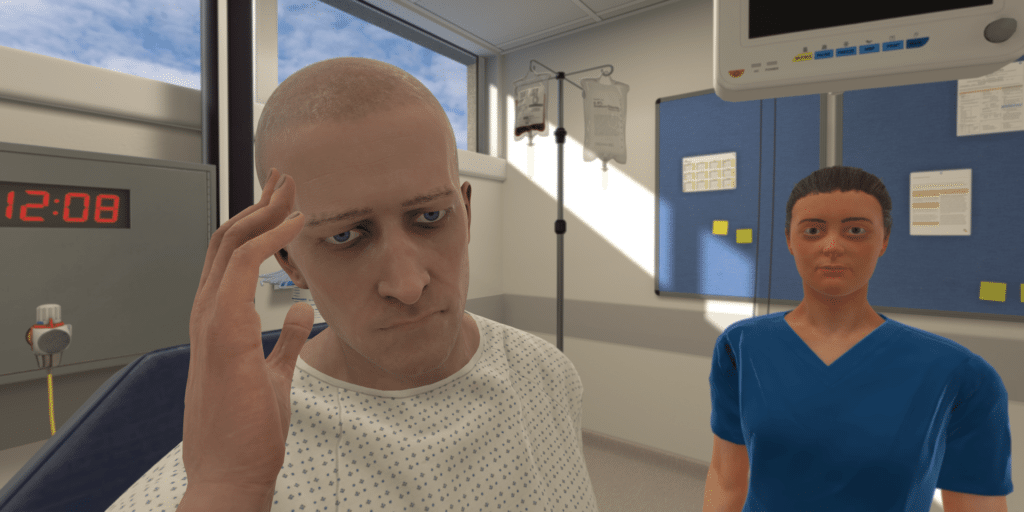
What makes AI-powered clinical simulations so impactful is the fact that learners can practice complex or difficult conversations without real-world consequences. They can experiment with different communication approaches, see how the virtual patient responds, and develop the adaptability that’s so difficult to practice by more traditional means.
OMS Communication scenarios give educators the tools to teach and assess:
• Establishing trust and building rapport with patients across a range of presentations
• Sensitive discussions around personal topics like loneliness, memory, and end-of-life care
• De-escalation with distressed patients or relatives
• Motivational interviewing and shared decision-making
• Demonstrating accountability and service recovery when gaps in care are identified
• Structured interprofessional handovers using the SBAR (Situation, Background, Assessment, Recommendation) format
SBAR proficiency is a great example of the importance of delivering a complete, structured handover to another clinician. It’s one of the most high-stakes communication skills in practice. Incomplete or unclear handoffs are a well-documented contributor to adverse events, and by practising SBAR in VR simulation, learners mitigate that real-world risk before it ever arises.
Built for Educators. Flexible Across Cohorts.
One of the most practical challenges for healthcare educators is delivering consistent, high-quality simulation across multiple professional cohorts. The same communication skills – empathy, SBAR, rapport-building – matter whether you’re teaching NP students, medical students, PAs, or RNs.
OMS scenarios are designed with that breadth in mind. A single scenario can be deployed across different cohorts, giving educators a flexible tool that works across the curriculum without requiring separate resources for each profession.
When providing care to patients, it’s not only essential to communicate clearly, it’s also vital to listen, understand, and demonstrate that understanding in an empathic and patient-centered way.
If you’d like to see a demonstration of voice control in action, or explore how OMS
Communication scenarios can work across your program, get in touch with us.
Related




Ready to get real?
See how OMS can help your organization build confidence, competence, and clinical readiness for today’s healthcare.

